
Flu Hospitalizations Are Up 367% From Last Year. Here Are 7 Reasons It Keeps Getting Into Your House, and the 15-Second Habit Families Are Adding at the Front Door
ER waiting rooms are packed. Pharmacy lines wrap around the aisle. Positive flu tests are 14 times higher than this time last year, and the peak has not even started. Here is how the flu is getting into your house, and the one place almost nobody is protecting.

If you have sat in an emergency room waiting room this fall, you already know.
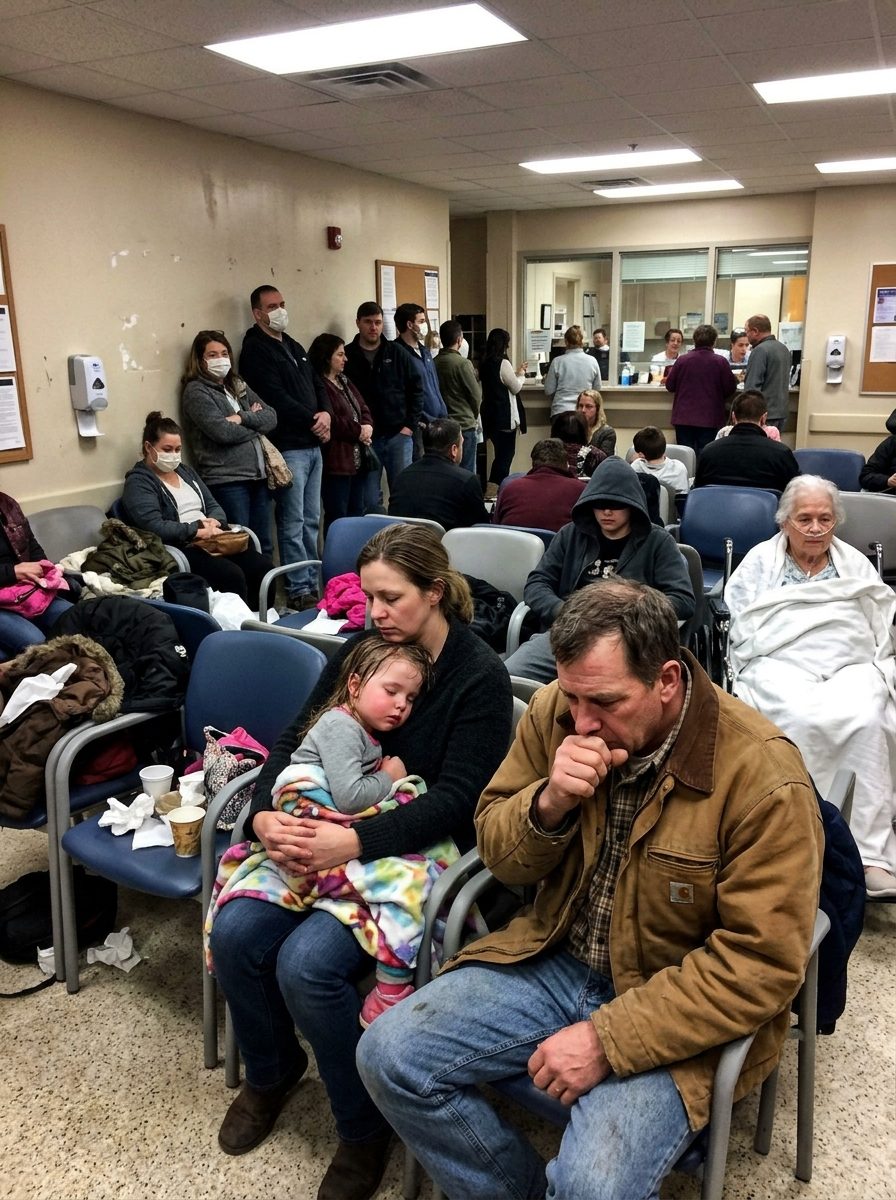
Every chair taken. People standing along the walls. A cough from the corner, a wet one two seats down, a little girl asleep across her mother's lap with her cheeks bright red. A man coughs into his bare hand and puts that hand flat on the armrest you are about to touch. The doors open every few minutes, a nurse calls one name, every head comes up at once, and then the coughing starts again.
One mother we heard from took her eight-year-old in for a broken wrist. Not the flu. A wrist. They sat in that room for six hours and forty minutes. Three days later her son had a fever of 102.4. Two days after that she was lying on her bathroom floor because the tile was the only thing that felt cold. Then her husband. Then her three-year-old, whose breathing changed on the fourth night, fast and shallow with a little catch at the end, while her mother sat on the edge of the bed in the dark counting every breath.
"We went in for a wrist," she told us. "We came home with the flu. All four of us. Because we sat in the wrong room and breathed the wrong air for six hours, and there was not one thing I knew how to do about it."
"On the fourth night I sat on the edge of my three-year-old's bed in the dark, counting every breath."A mother of two, after six hours in an ER waiting room
That last sentence is the reason this report exists. Because there is one thing. Almost nobody has been told about it. And it starts with understanding exactly how the flu gets into your house.
#1 The Waiting Room Is One of the Most Dangerous Rooms You Will Sit In This Winter.
Think about what a waiting room actually is during flu season. Dozens of people, many of them sick, sitting shoulder to shoulder for hours in a closed room where the air barely moves. Nobody chose to be there. Half of them came in for something else entirely: a sprained ankle, a stomach ache, a stitch, a parent who fell. And all of them are breathing the same air, in and out, for as long as the wait lasts.
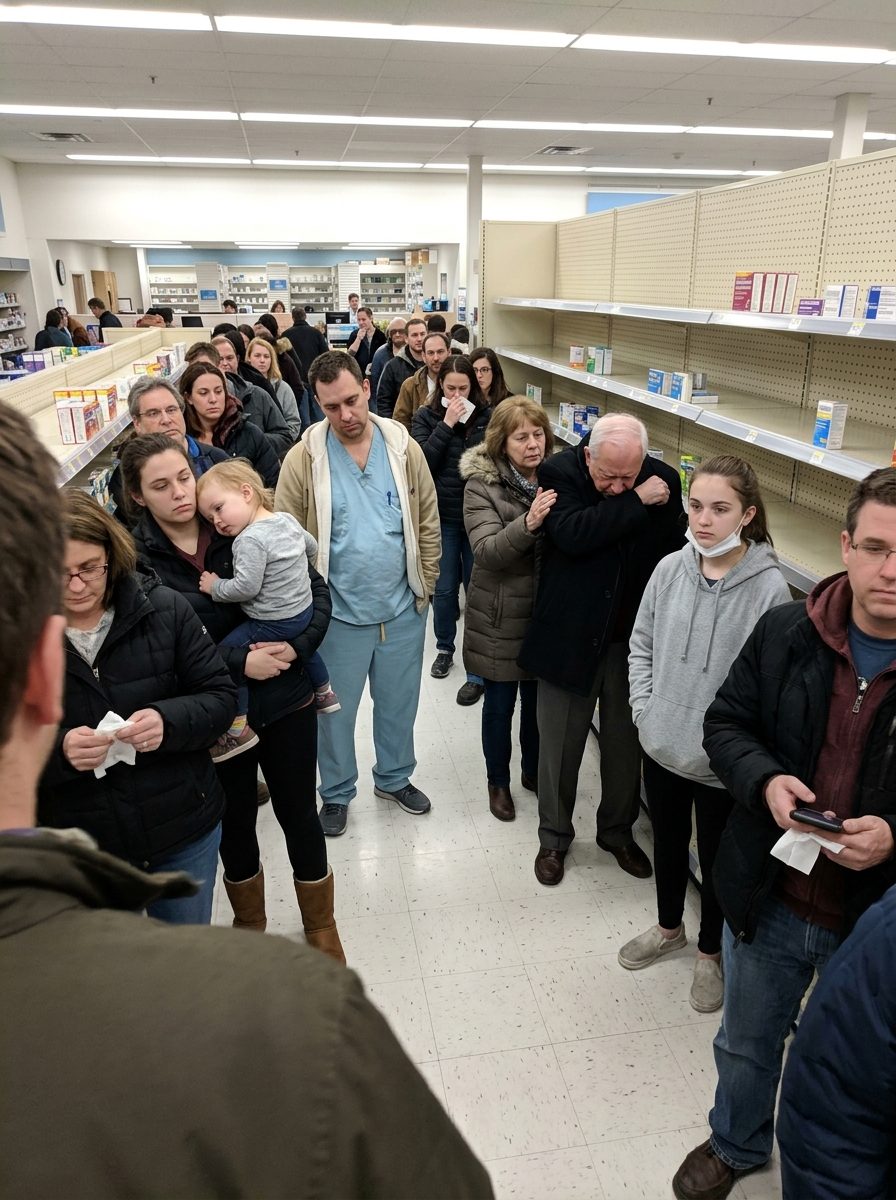
And it is not only the ER. It is the urgent care with a handwritten sign on the door that says the wait is four hours. It is the pharmacy, where the line now runs from the counter down the cold and flu aisle and around the corner into the greeting cards, and the shelf where the children's fever reducer used to be is nothing but empty metal pegs. It is the pediatrician's office, the school nurse's office with one child on the cot and another lying on the floor on top of somebody's coat because there is nowhere else to put him.
You cannot avoid every room. You cannot keep your kids home all winter. You cannot stop breathing. So the real question is not how to avoid the air. It is what happens to that air once it is inside you.
#2 You Are Contagious Before You Know You Are Sick. By the Time You Feel It, It Has Been Inside for Days.
This is the part of flu season that makes it so hard to stop, and the part almost nobody understands.
According to the CDC, people with the flu can spread it to others about a day before they feel any symptoms at all. Young children can spread it even longer. Which means the most dangerous person in any room is not the one who is coughing. It is the one who feels perfectly fine.
Here is what that looks like, hour by hour.
By the time you know it is there, the window for stopping it at the door has already closed. Every remedy in your cabinet is now playing catch-up.
Now picture a classroom. A seven-year-old comes in "a little tired." He sits at the reading table with four other kids, sharing a basket of books, for an hour and a half before anyone notices his cheeks are pink. His teacher wipes down the table, the books and the chair after the nurse takes him. She knows while she is doing it that it does not matter. He has been breathing in that room since 8:05. By the end of the week, nine desks are empty.
That is the trap. You cannot be careful in the moment, because the dangerous moment happened days before anyone had a symptom to be careful about.
#3 It Starts in Your Nose, Not Your Chest. Every Breath Goes Through the Same Door.
We think of the flu as something that happens in the chest and the throat. That is where we feel it. But that is not where it starts.
It starts in the nose.
You breathe roughly twenty thousand times a day, and nearly every one of those breaths passes through your nose first. When someone coughs, sneezes or simply talks near you, the germs float in the air, you breathe them in, and they land on the lining inside your nose. That is where they settle. That is where they multiply.
Your hands are part of the story too, but not the way most people think. Researchers who filmed people during an ordinary day found they touched their faces about 23 times an hour, and almost half of those touches landed on the mouth, nose or eyes. Your hands do not get you sick. Your hands carry it to the door.
We sanitize our hands at every entrance. We wipe down the grocery cart. We wash our hands forty times a day. We brush our teeth twice a day and clean the kitchen every night.
But the one place every single breath goes through, the place where the flu actually lands and starts multiplying, nobody ever cleans.
SEE THE 15-SECOND NOSE HABIT →#4 Grandparents Pay the Price for a Child's "Little Sniffle."
If there is one story that explains why this matters, it is this one.
A woman told us about her father. Seventy-two. Thirty-four years at the same lumber yard. Built the deck behind his house by himself the summer he turned sixty. Shovels his own driveway and then crosses the street to shovel the widow's.
Last Thanksgiving, her four-year-old nephew had "a little sniffle." No fever. Running around, eating everything in sight. During the parade he climbed into Grandpa's lap in the recliner, they shared a bag of chips, and when the family left that night Grandpa kissed the top of his head at the door.

Two days later she found her father sitting at his kitchen table in his winter coat with the thermostat on 78, shivering, his lips gone gray. His breathing sounded, she said, "like someone dragging a heavy chair across a wooden floor."
At the hospital there were no rooms. He spent his first night on a bed in a hallway, beds lined up head to foot along both walls, a curtain that did not close, a woman beside him coughing so hard she was crying, a monitor down the hall beeping for eleven minutes with no one free to turn it off. Her father, the man who built a deck by himself, lay there in a paper gown and asked her if she had remembered to feed his dog.

On the sixth night his oxygen number dropped to 86. Two nurses came running and asked her to wait in the hall, and she stood there with her hand over her mouth, listening to them talk to her father in the calm, careful voices nurses use when they are not calm at all. Later that week, with the fever and the lights that never turn off, he got confused. He called her by her mother's name. Her mother has been gone eleven years. He held her hand and asked if the kids were home from school yet. He meant her and her sister. He thought it was 1989.
"I sat in the dark after that and did the math I had been avoiding," she told us. "If he didn't come home, my nephew would grow up remembering his grandfather as a man in a recliner who let him hold the remote one Thanksgiving. That would be the whole memory. And it would have started with a bag of chips."
The flu became pneumonia. He spent nine days in the hospital. He came home, but he is not the same man. He used to walk two miles every morning. Now he walks to the end of the block and stops at the mailbox to rest.
"He looked up at me from a hallway bed in a paper gown and asked if I had remembered to feed his dog."A daughter, about her 72-year-old father
Her nephew was fine in two days.
"Nobody did anything wrong," she said. "That is what I keep coming back to. My sister didn't know. He didn't know. Kids carry it around like it's nothing. They bounce back. Grandparents don't always."
That is the cruelty of the flu. The people who bring it into the house almost never feel sick enough to stay away. And the oldest, most fragile person in the room is usually the one who pays for it.
#5 Everything in Your Medicine Cabinet Is Aimed at the Wrong Place.
Open your medicine cabinet right now. If your house is like most, you will find some combination of these. Here is what each one actually does.
Get your flu shot. Wash your hands. Stay home when you are sick. All of that matters. But notice what every item on that list has in common: not one of them does anything about the door.
The flu shot trains your body to fight it once it is inside. Vitamins work from the inside. Sanitizer works on your hands. Everything else is for after.
Nothing on that shelf cleans the one place every breath goes through, before the germs have days to settle in.
#6 What the People Who Cannot Afford to Get Sick Have Been Doing.
Think about the people who breathe this air all winter long. The triage nurse who works the waiting room twelve hours a shift. The respiratory therapist. The paramedic. The second-grade teacher with twenty-three coughing seven-year-olds and the windows shut because it is thirty-eight degrees outside.
The mother from our first story went back a few weeks later to have her son's cast checked, and the triage nurse was the same woman who had been working the night they came in. She asked her: you sit in that room all day, every day, all winter. How are you not sick all the time?
The nurse reached into the pocket of her scrubs and held up a small amber spray bottle. "Iodine," she said. "In my nose. Before every shift and after."
The teacher heard almost the same words in her school's pickup line, from a father who works nights in an emergency department and picks up his daughter still in his scrubs. He held up the bottle, said "before I walk in and when I walk out," and then sprayed his daughter's nose right there, two quick sprays on each side. She wrinkled her face, giggled and climbed into the car like she had done it a hundred times.
"Iodine. In my nose. Before every shift and after."A triage nurse, asked how she gets through flu season
Iodine is not new. It is one of the oldest and most trusted antiseptics in medicine. It is the same brown solution painted on your skin before surgery. Hospitals have trusted it to kill germs for more than 150 years. It works on contact. It does not care what this year's strain is called.
And these people were putting it in exactly one place. The door.
#7 Why Nobody Ever Told You About the Door.
If this is so simple, why has your doctor never mentioned it? Why is there no commercial for it between the cough syrup ads?
The honest answer is boring. Iodine is old. It is cheap. Nobody owns it. There is no billion-dollar company behind it, no drug rep handing out samples, no celebrity, no jingle. It just sits in every hospital in the country, quietly doing its job, while the rest of us buy gummies.
There was also a practical problem. The old brown hospital iodine stings, stains and dries. Nobody wanted to put it in their nose every morning. So for most families it simply never came up.
What changed is the formula. Iodine can now be made gentle enough to use in the nose every single day. That is what the nurse had in her pocket. And that is what Puleia is.
#8 Meet Puleia: Hand Sanitizer for Your Nose.

- 1% iodine (from potassium iodide): the antiseptic hospitals have trusted for over 150 years
- Kills 99.99% of germs right inside the nose, at the door
- Fulvic acid, a natural mineral complex that keeps it gentle enough for every day
- No steroid · no decongestant · no rebound · non-habit forming
- Made in the USA · one-time purchase, no subscription
Puleia is a small nasal spray made for flu season. Every spray puts 1% iodine plus fulvic acid straight into your nose, the first place germs land every time you breathe. The iodine kills 99.99% of germs on contact. The fulvic acid pairs with it and keeps it gentle, so instead of the sting of old hospital iodine you feel a brief tingle for a second or two, and then nothing.
Think of it the way you think of hand sanitizer. You would never walk out of a crowded hospital or a packed pharmacy and eat lunch without cleaning your hands. Puleia gives your nose the same step.
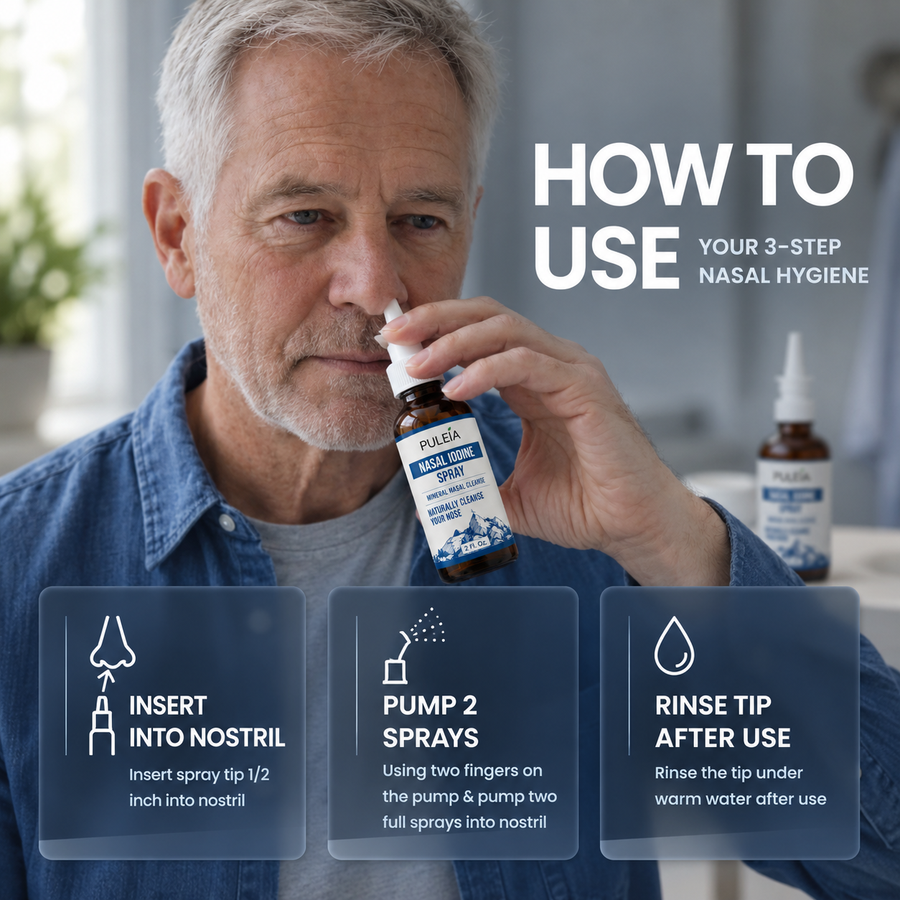
How to use it: tilt your head forward and place the tip about half an inch into the nostril. Press the pump, one or two sprays in each nostril. Let it sit for fifteen to thirty seconds. Rinse the tip. Use it one to three times a day, every day of flu season.
#9 Honesty: What Puleia Does, and What It Does Not.
We want to be precise here, because precision is the reason you should trust the rest of this report.
What it is: a daily nasal cleanse. A fast, simple way to kill 99.99% of germs at the one place they enter, before they have days to settle in and multiply. The habit the people who breathe sick air all winter have been using for themselves.
What it is not: it is not a vaccine, and it is not a replacement for your flu shot. It is not a medicine for a flu you already have. It is not a reason to stop washing your hands or to go to work with a fever.
It protects the door. That is the whole job, and it is the job nothing else in your cabinet does.
Who should check with a doctor first: if you are pregnant or nursing, have a thyroid condition or take thyroid medication, or are allergic to iodine, talk to your doctor before using Puleia. For young children, an adult should help with the spray and follow the dose on the label.
#10 The Front Door Rule: Where Families Keep It.
The families who swear by Puleia almost all describe the same routine. It is not complicated, and that is why it works.
The mother from the waiting room keeps three bottles now: one by the door, one in her purse, one in her son's backpack. "I think about those six hours all the time," she said. "If I had had it in my purse that night, I would have used it in the first ten minutes. I would have sprayed my son. I would have had something to do besides pull my shirt over my nose and pray."
"If I had had it in my purse that night, I would have used it in the first ten minutes."The mother from the waiting room
What Customers Are Saying
I don't know if it's luck or this spray but everyone around me has been getting sick and somehow I've been fine 😂 I've been using it every morning and after work. Whatever it's doing, I'm not stopping now.
Kelly T., 41 · Verified buyerI was VERY skeptical when I ordered this lol. My husband was already sick and I started using it right away. I somehow never got what he had. I'm definitely using it all winter.
Mark T., 52My kids seem to bring everything home from school, so we added this to our routine this year. So far everyone's been doing great. I'm definitely not stopping now 😂
Lauren P., 37Bought one just to try it and I'm already coming back for more. I keep one in my bathroom but I want another for my bag and one at work. Super easy to use and honestly I love this stuff.
Amanda R., 38This takes like 5 seconds so I actually stick with it. Mine sits beside the hand soap and I use it when I get home from being around people. I've felt great so far and I'm really happy I found it.
Verified buyer#11 The Peak Has Not Hit. Thanksgiving Is in 30 Days. Guard the Door Now.
Everything in this report, the packed waiting rooms, the hallway beds, the line around the pharmacy, the nine empty desks in a second-grade classroom, happened in October.
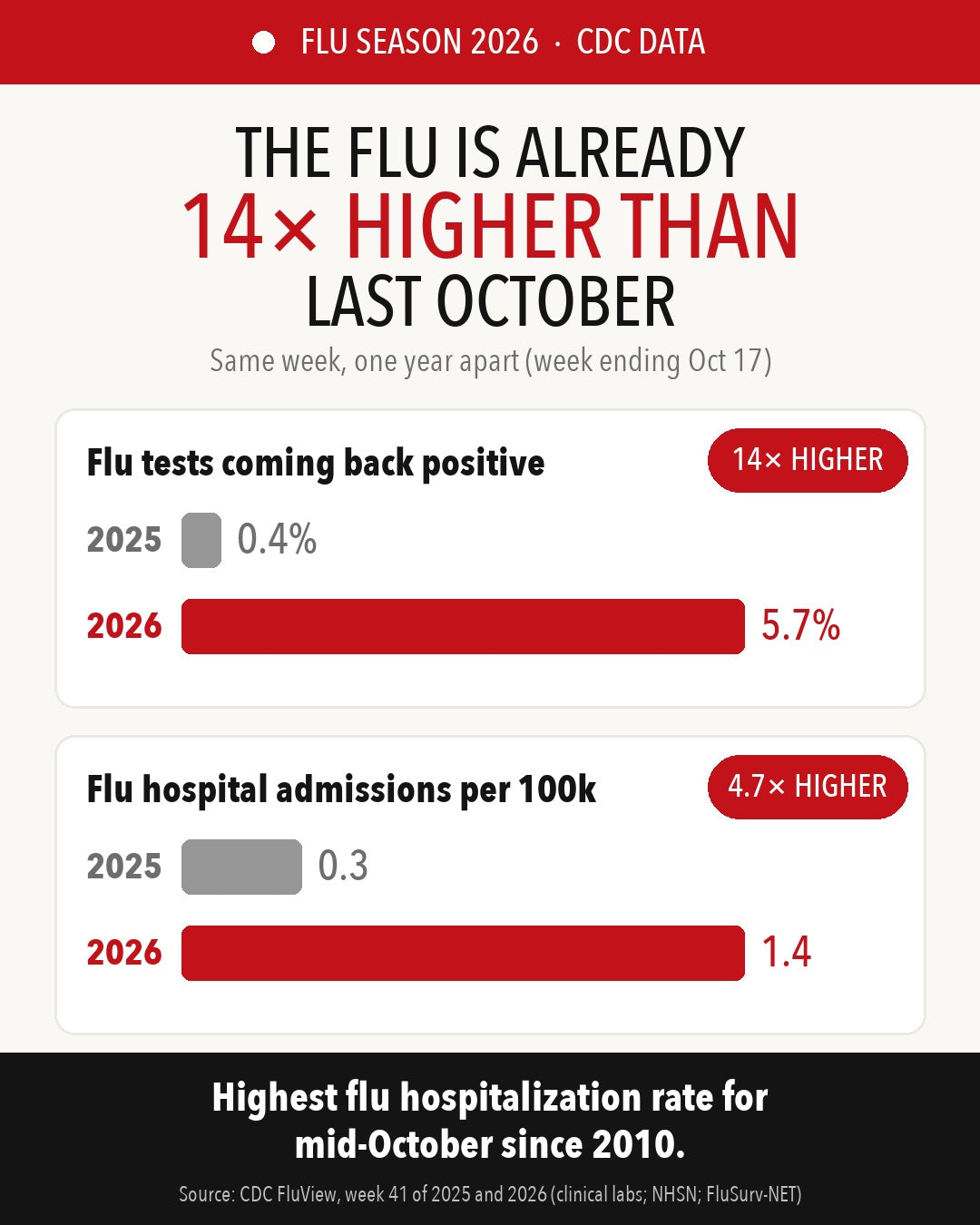
And the numbers back it up. In the CDC's own weekly flu report for the week ending October 17th, 5.7% of flu tests nationwide came back positive. The same week last year, it was 0.4%. That is fourteen times higher. Flu hospital admissions were nearly five times last year's rate for the same week, and the CDC noted that its hospitalization rate for that week was the highest since the 2010–2011 season.
Flu season usually peaks between December and February. The hardest part of the season has not even started yet.
And in the next few weeks, the entire country is about to pack itself into warm, closed-up rooms. Thanksgiving on November 26th. Then Christmas, then New Year's. Airports and airplanes. Office parties. Church services. Living rooms full of grandparents, toddlers and cousins who just flew in from three different cities, all breathing the same air for hours.
Somewhere in every one of those rooms there will be someone who feels completely fine and is already spreading it. You will not know who. Neither will they.
That is why the timing matters so much. Puleia works at the door, and the door only matters before. Not after the first fever in your house. Not the Tuesday before Thanksgiving, when everyone is rushing. Now, while everyone you love still feels fine.

Puleia® Nasal Iodine Spray
Try Puleia for thirty days. If you do not love it, email us and get every dollar back.
You cannot go back and un-sit the waiting room. You cannot un-kiss the top of a little boy's head for his grandfather. But you can decide that this winter, every person who walks through your front door stops at one little table first.
Fifteen seconds. Two sprays in each nostril. At the door, before it ever gets in.
GUARD THE DOOR BEFORE THANKSGIVING →This article is a paid advertisement for Puleia. The stories in it are dramatizations that illustrate common experiences; they are not individual case reports. Puleia is a nasal cleanse, not a vaccine or a medicine, and is not intended to diagnose, treat, cure or prevent any disease. These statements have not been evaluated by the Food and Drug Administration. Do not use if you are pregnant or nursing; ask your doctor first if you have a thyroid condition, take thyroid medication or are allergic to iodine. Keep getting your annual flu shot and follow your doctor's advice. Sources: CDC, "How Flu Spreads"; CDC FluView weekly reports, weeks 41 of 2025 and 2026; Kwok YLA et al., "Face touching: a frequent habit that has implications for hand hygiene," Am J Infect Control 2015.
© 2026 Puleia · puleia.com